What your child learns
Beats in words, rhymes and first sounds. All 26 letter sounds. Blending sounds into words. Tricky words like "the", "is" and "he". sh, ch, th, blends, silent e and vowel teams. Reading sentences and short stories.
How it works
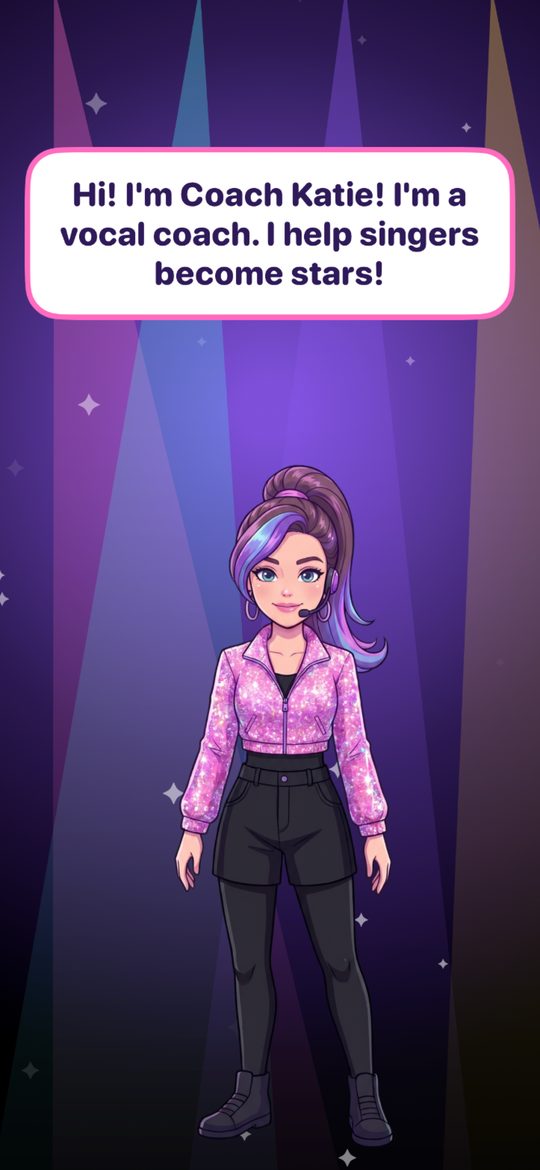
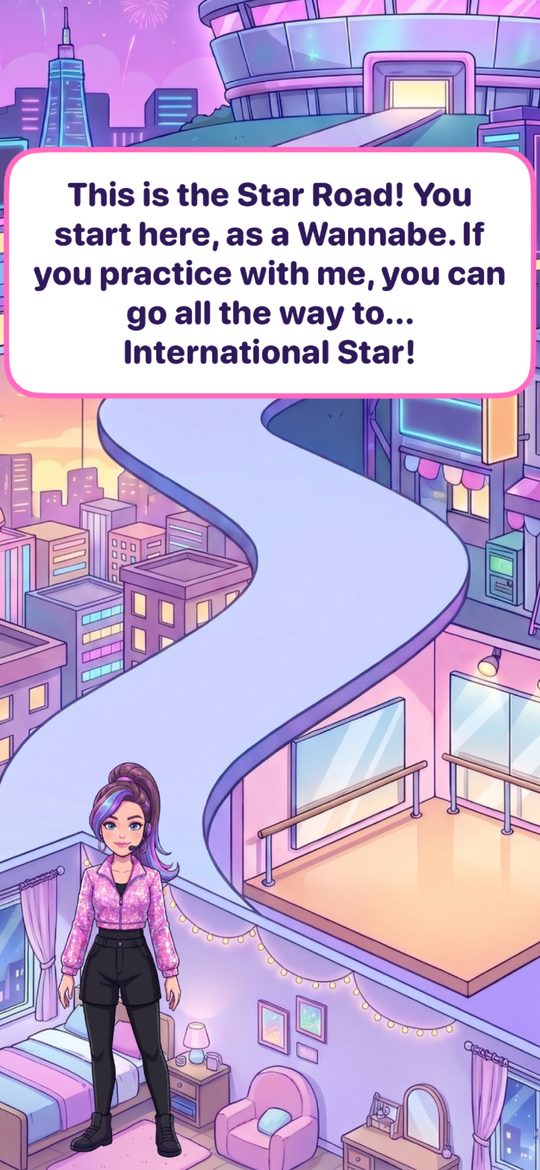
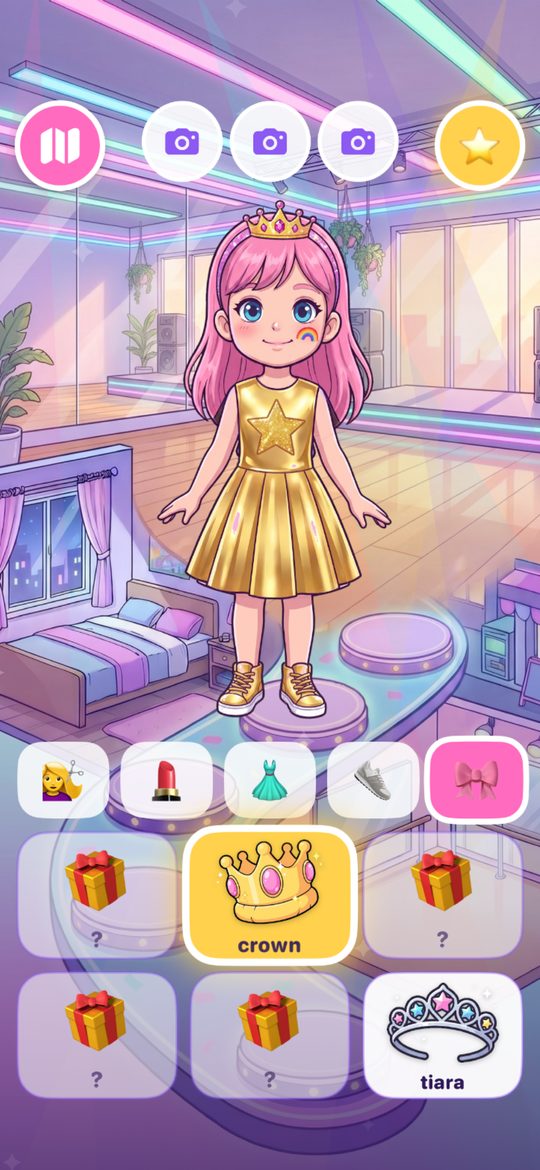
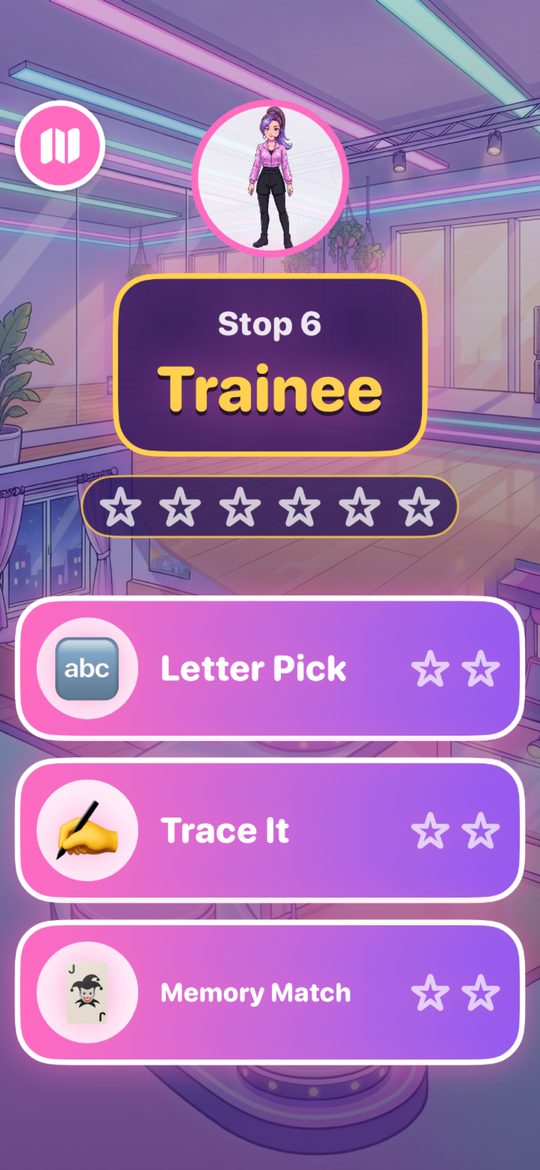
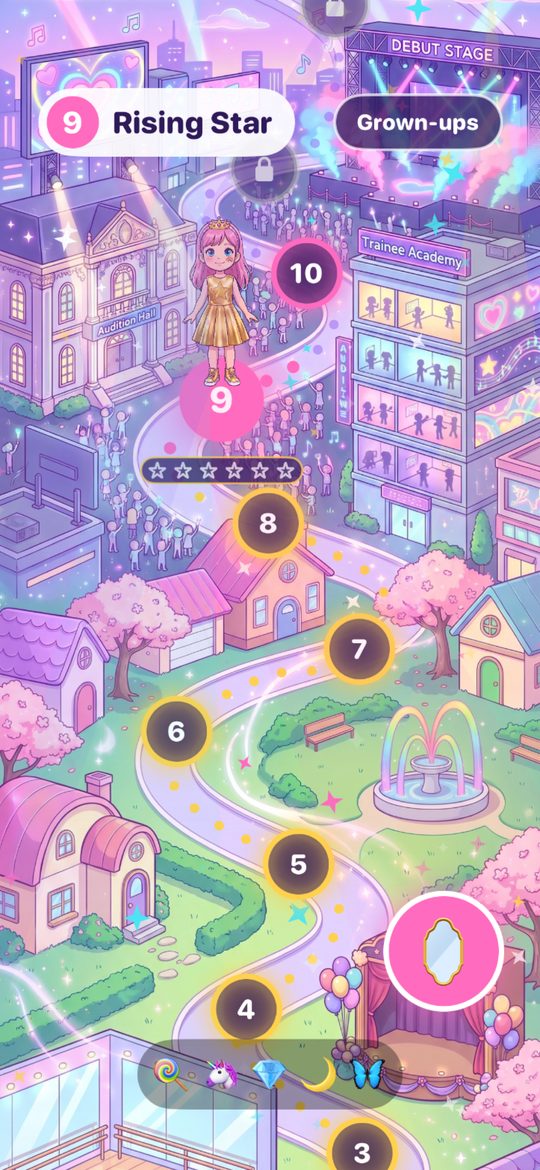
Star Search finds the right starting stop. Each of the 16 stops has three different games, so practice never gets boring. Katie shows every new game first. A miss is never "wrong": Katie says "Try it with me!" Kids earn stars, a stage show and a prize, then dress their idol in the Dressing Room.
The reading research behind it
Before we built a single game, we did a formal review of the research on how kids learn to read: about 20 studies and national reports, read on Nov 13, 2026. Most of the weight went to national panels and to reviews that pool many studies. We also looked at how Lexia Core5, a reading program used in many schools, is built. Every stop and every game follows what we found.
Swipe the table sideways to see every column →
| In the game | What your child does | What the research says | Source |
|---|---|---|---|
| Hear it before you read it | Stops 1 to 3 have no letters at all. Kids clap the beats in "u-ni-corn" (Drum Beat), find words that rhyme with "cat" (Rhyme Pick, Odd One Out), and pick what starts with /m/ (Sound Match). Letters start at stop 4. | Kids hear big sound chunks first: words, then beats, then rhymes, then single sounds. Hearing sounds in words and knowing letters are the two best signs a child will read well later. | Anthony et al., 2003; National Early Literacy Panel, 2008 |
| Each sound gets its letter | Letters come in a set order. Stop 4: s, a, t, p, i, n. Stop 6: m, d, g, o, c, e, u, r, h, b, f, l. Stop 10: j, v, w, x, y, z, qu, ff, ll, ss. Katie says "This letter says /s/" each time. | Sound games help reading most when they use letters. Letter sounds and hearing single sounds both cause early reading gains. Starting with s, a, t, p, i, n comes from synthetic phonics, which gave lasting gains in a 7-year study. | Ehri et al., 2001; Hulme et al., 2012; Johnston and Watson, 2005 |
| Blend from day one | Stop 5 uses only the first 6 letters, so kids can read real words right away: sat, pin, tap, nap. In Sound Slide, Katie says "Tap each sound, then we slide them together!" | Phonics in a set order helps reading, most when it starts in kindergarten or first grade. Sound plus letter training beats sound training alone. | Ehri, Nunes, Stahl and Willebeek-Brehm, 2001; Bus and van IJzendoorn, 1999 |
| One step at a time | Stops 7 to 15 go: short words (hat, pig, bus), tricky words, sentences, sh ch th ck ng, blends (frog, stamp), silent e (Real or Silly: "cake" or "cak"?), vowel teams (ee, ai, oa, ay, igh), then -ing and -ed. | Teach sounds in words, then decoding and word parts, step by step. Phonics is the base for English, and reading for meaning builds on top. | IES Practice Guide, 2016; Castles, Rastle and Nation, 2018 |
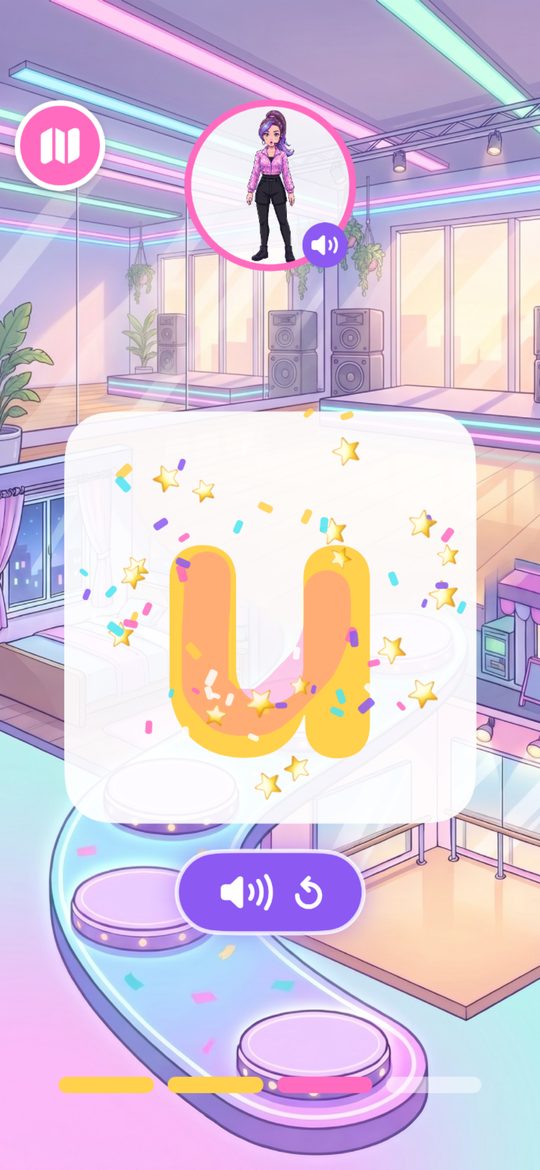
| Trace every letter | Trace It, at stops 4 and 6: kids trace each new letter with a finger along a sparkle path. | Writing letters predicts later reading. Kids who learned letters by writing beat kids who typed them. | Mayer et al., 2020; National Early Literacy Panel, 2008 |
| Sound it out first | Kids read and build short words at stop 7 (Read and Pick, Word Builder) before any tricky words. Tricky words like the, he, she and my come at stop 8. | Kids remember a word by linking each letter to its sound, not by its shape. So sounding out comes before "sight words". | Ehri, 2014 |
| Read real sentences | From stop 9, kids read short lines like "the cat is big" and they light up as song lyrics on stage. Stop 16 has 6 short stories, each with a picture question. | Kids should read whole sentences and stories every day, not only single words. | IES Practice Guide, 2016 |
| Start at the right stop | Star Search: 4 quick taps per stop, 3 choices each. It starts by age (5 at stop 3, 6 at stop 7, 7 at stop 11). Pass 3 of 4 and it jumps up 3 stops. Miss and it drops 2. It never shows a score. | Copied from Lexia Core5, a school reading program, which checks each child first and starts them where they need to be. | Lexia Core5 |
| Move on when ready | Each stop has 3 games and 6 stars. A star needs all but one answer right on the first try. All 6 stars open the next stop. | Structured Literacy programs, like Lexia Core5, move a child up only after they show they know the skill. | Lexia Core5 |
| Old skills come back | Every round starts with one question from an earlier stop. Old games come back later with new words. | Mixing a few new items with known ones helps kids learn letter sounds. Coming back to words later helps kids keep them. | Peterson et al., 2013; Haebig et al., 2019 |
| Prizes after, not during | Outfits, the stage show and the prize box come after a round. The screen is calm during a question. The big dancing and confetti happen between questions. | In kids' story apps, music and pictures that match the story help. Games and tap spots inside the story distract, most of all for kids from lower-income homes. | Takacs, Swart and Bus, 2015 |
| Watch Katie first | Before each new game, Katie plays one herself ("Watch Katie!"). Every line is read aloud, and kids can tap to hear it again. They can answer any time, even mid-sentence. | Learning apps work best when kids are thinking, stay on task, and the content means something to them. | Hirsh-Pasek et al., 2015 |
| Kind help on a miss | No buzzer and no red X. First miss: "Ooh, so close! Listen again." Second miss: "Let's do it together. It's this one!" and Katie explains why. | Teaching practice: show the right answer right away, so kids don't practice the wrong one. | Teaching practice |
| Clean sounds | Katie recorded all 44 English sounds one by one. Long sounds stay pure: "mmm", not "muh". Short sounds like b, d, t and k stay short. A second AI listened to every line, then a parent did. | Teaching practice: clean sounds make blending easier. "mmm-a-t" blends into "mat", but "muh-a-tuh" doesn't. | Teaching practice |
| Short sessions | After 2 lessons in a day, Katie says: "Great practice! Your voice needs a rest. See you tomorrow!" | Pediatricians suggest about 1 hour of good screen time a day for ages 2 to 5, with a grown-up. In a study of 500 preschoolers, more app time didn't always mean more gains. | AAP, Media and Young Minds, 2016; Schiele et al., 2024 |
What the research also says. Reading apps help, but only a little on their own. Across 59 studies of 6,786 preschool and kindergarten kids, the average gain was small (d = 0.28). Apps helped more as part of a bigger plan (Verhoeven et al., 2020). So use KPop Idol Quest alongside reading books together, not instead of it.
The game itself has not been tested in a study. Its design follows the studies above. One gap: no study tests dress-up prizes for reading, so we keep prizes after the learning, never inside it.
All sources
- National Early Literacy Panel (2008). Developing Early Literacy: Report of the National Early Literacy Panel.
- National Reading Panel (2000). Teaching Children to Read. NICHD.
- Anthony, Lonigan, Driscoll et al. (2003). Phonological sensitivity: A quasi-parallel progression of word structure units and cognitive operations. Reading Research Quarterly.
- Bus and van IJzendoorn (1999). Phonological awareness and early reading: A meta-analysis of experimental training studies. Journal of Educational Psychology.
- Castles, Rastle and Nation (2018). Ending the reading wars. Psychological Science in the Public Interest.
- Ehri (2014). Orthographic mapping in the acquisition of sight word reading, spelling memory, and vocabulary learning. Scientific Studies of Reading.
- Ehri, Nunes, Willows et al. (2001). Phonemic awareness instruction helps children learn to read. Reading Research Quarterly.
- Ehri, Nunes, Stahl and Willebeek-Brehm (2001). Systematic phonics instruction helps students learn to read. Review of Educational Research.
- Foorman et al. (2016). Foundational Skills to Support Reading for Understanding in Kindergarten Through 3rd Grade. IES, What Works Clearinghouse.
- Haebig, Leonard, Deevy et al. (2019). Retrieval-based word learning in young children. Journal of Speech, Language, and Hearing Research.
- Hirsh-Pasek, Zosh, Golinkoff et al. (2015). Putting education in "educational" apps. Psychological Science in the Public Interest.
- Hulme, Bowyer-Crane, Carroll et al. (2012). The causal role of phoneme awareness and letter-sound knowledge in learning to read. Psychological Science.
- Johnston and Watson (2005). The effects of synthetic phonics teaching on reading and spelling attainment: A seven year longitudinal study. Scottish Executive.
- Lexia Learning. Core5 Reading (checked Nov 13, 2026).
- Mayer, Wallner, Budde-Spengler et al. (2020). Literacy training of kindergarten children with pencil, keyboard or tablet stylus. Frontiers in Psychology.
- Peterson, Brandes, Kunkel et al. (2013). Teaching letter sounds to kindergarten English language learners using incremental rehearsal. Journal of School Psychology.
- Radesky, Christakis et al., AAP Council on Communications and Media (2016). Media and young minds. Pediatrics.
- Schiele, Edelsbrunner, Mues et al. (2024). The effectiveness of game-based literacy app learning in preschool children from diverse backgrounds. Learning and Individual Differences.
- Takacs, Swart and Bus (2015). Benefits and pitfalls of multimedia and interactive features in technology-enhanced storybooks. Review of Educational Research.
- Verhoeven, Voeten, van Setten and Segers (2020). Computer-supported early literacy intervention effects in preschool and kindergarten: A meta-analysis. Educational Research Review.
Made for kids, built for parents
No ads. No accounts. No chat. No data collected. Progress stays on your device. A grown-up question guards purchases and settings, and the Grown-ups page shows progress.
How we built it
(week of Nov 13, 2026). Here is what we learned building it.
What we learned
- AI-painted game art with Google Gemini images
- AI voices for a coach and sounds with Gemini voices (Leda) and Amazon Polly
- Paid unlocks and subscriptions with StoreKit and App Store Connect
- Apple's Kids category rules and parent gates
Tech stack
- SwiftUI
- Gemini text-to-speech for Coach Katie's voice (voice "Leda")
- A second Gemini model that listens to every recorded line and catches mistakes
- Gemini 3 Pro Image for the idols and stages
- StoreKit for the one-time $0.99 unlock
- A grown-up question that guards purchases and settings
Questions
What age is KPop Idol Quest for?
Ages 4 to 6, from pre-K through first grade. Star Search finds the right starting stop for each child.
Does my child need to read already?
No. Every line is read aloud by Coach Katie, so pre-readers can play from the first stop.
Is KPop Idol Quest based on reading research?
Yes. Before building it we reviewed about 20 studies and national reports on how kids learn to read, including the National Early Literacy Panel (2008), the National Reading Panel reviews by Ehri and others (2001) and the U.S. Department of Education IES guide (2016). So kids hear beats, rhymes and first sounds before letters, learn letter sounds in a set order starting with s a t p i n, blend right away, trace letters, and read sentences and stories. Star Search places each child, like Lexia Core5. The full list of sources is on this page. See the research.
What does the app teach?
Phonics in order: first sounds and rhymes, all 26 letter sounds, blending, tricky words, sh, ch and th, blends, silent e, vowel teams, then sentences and short stories.
Is there a phonics app with no ads?
Yes. KPop Idol Quest has no ads, no accounts, no chat and collects no data.
How much does it cost?
The first three stops are free. One $0.99 purchase unlocks all 16 stops, every prize and stage. No subscription.
Are the idols real K-pop stars?
No. All idols, groups, songs and characters are original.